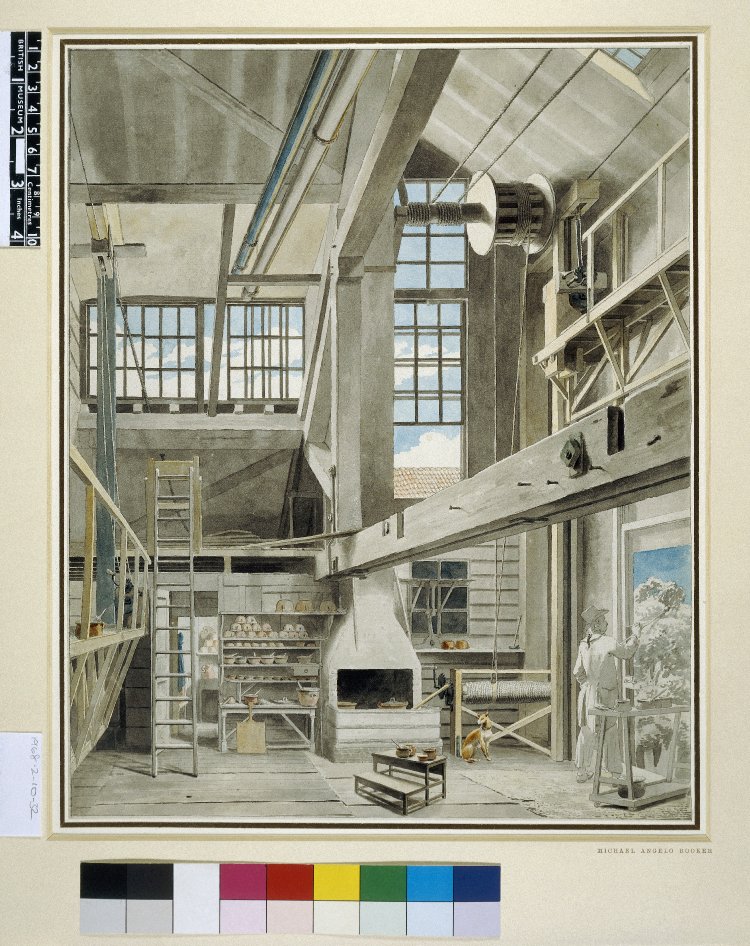
Michael Angelo Rooker’s water-colour illustrating himself at work is one of the most remarkable paintings in theatre history. Rarely has a theatre artisan presented himself in this way, and no other representation of a scene-room in this country is known until 1874, when a wood-engraving appeared in The Illustrated Sporting and Dramatic News for 19th December of that year.
Rooker was the son of Edward Rooker and was sometimes known by the mock Italian soubriquet of “Signor Rookerini.” His first touch with drama came when he sketched the procession in Garrick’s Jubilee, but later developed into an accomplished landscapist and topographer. George Colman engaged him as a scene-painter to the Little Theatre in the Haymarket in 1779, where he remained until 1797. It was here Rooker depicted himself in slouch hat and tie-wig, in old clothes and loose seaman’s trousers painting a landscape back-drop in a scene frame. According to Sybil Mary Rosenfeld in her article about Rooker:
‘The frames were let down through a slot in the floor when the upper part of the cloth had to be painted… It is possible that the platform with its paint pots on the left of Rooker’s water-colour depicts this kind of hanging method in use here. Two rolled drop-scenes are visible above the window and below is an oven for heating the size… Rooker is touching in a detail with a short brush and mahlstick.’
Rooker was acclaimed in his time, but more importantly he left for posterity an insight into the 18th century scene painter’s world.