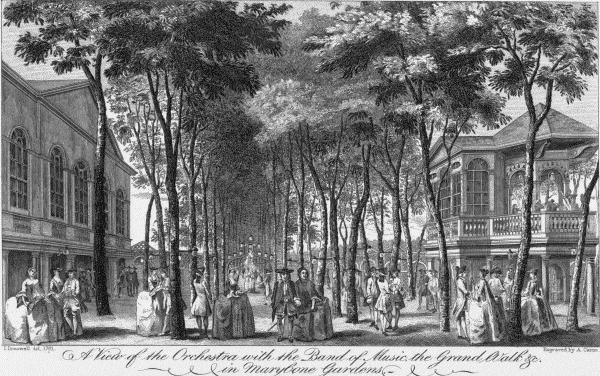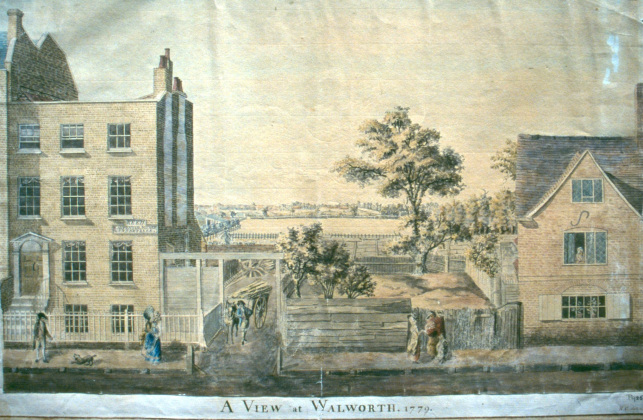
During the late 1780s, my 4xgreat uncle, George Aram settled in Newington, Surrey after having left the Norfolk coast for business opportunities in London. By 1793 he was a licensed victualler working in Newington [1] and in 1797 he is shown living in Charlotte Row.[2]
It was at some point during this period, he took ownership of the Montpelier Tea Garden in Walworth from Mr John Bendall. Both the Licensed Victualler records and the Surrey Jury Freeholder’s lists show Bendall in Newington up to 1790[3], thereafter he disappears from these records. There is a possibility that George took over the management of Montpelier as early as 1793. Certainly by 1795, he had accrued considerable land and holdings.[4]
Bendall’s gardens were established in the 1770s, before finally closing in 1844, long after George Aram’s death.[5] George’s legacy would live on and can still be seen and enjoyed today thanks to the Montpelier Cricket Club.
There is a vivid description of the Montpelier Gardens, in what was then a scenic, rural route, on the highway into London courtesy of the South London Chronicle.[6] This history of the garden, published on 5th November 1887, was written by H. Syer Cuming, an antiquarian with ambitions to document the establishment of pleasure gardens south of the river.
He writes:
‘This once fashionable establishment owed its origin to Mr. John Bendal, who at first occupied the ground which was about five acres in extent, as a market-garden, but upon which he afterwards built the renowned Montpelier Tavern, and laid out the lands in a tasteful manner with a spacious greensward and gravel-walks flanked with choice shrubs and trees, the whole area being belted with fine lofty elm trees. The old tavern was a very picturesque structure, and retained its primal aspect until its removal to give place to the present palace. It was a long and rather low building which lath and plaster and weather boarding played a principal part. The white front faced the south and had a railed gallery covered by a veranda running the whole length of the building, which was reached by a flight of steps at its eastern end, and from this gallery access was gained to the great room where many a stately banquet was served in the good old days “when George the Third was king,” and where his Majesty’s Jubilee was celebrated by a dinner on October 25th, tickets to which were 10s. 6d. each. The floor of the gallery formed the roof of the bar where refreshments were furnished to the frequenters of the gardens, and between the windows of the house backing this department were suspended several huge turtle shells, mementoes of the soup which had been at divers times consumed within the walls of the tavern. The public bar was at the end of the house next Princes-street, which led up to the gardens from the Walworth-road. Before quitting the tavern it may be well to record here was kept for the amusement of the guests a great ring puzzle, and one of the long tricky glasses, called an ale-yard, which sent the liquor with a rude splash into the face of the novice who essayed to drink from it. Many a wager has been lost and few won through the attempt to drain the ale-yard.
‘The tea gardens in front of the tavern were a large, irregular space, neither square, round nor oval, but a sort of compound of all three forms in one. A good part of its borders were filled up with gaily-painted boxes, each with benches fixed to the back and sides and with a table in the middle, and here persons were wont to be served with tea at 6d. per head. Dotted about were turfy banks or low knolls, crowned by ponderous examples of the gigantic clam-shell (Tridaena gigas), and in the centre was the broad level grassplot upon which the volunteers of old used to assemble for drill, and where, on Monday September 2nd, 1799, they were presented with their colours, which, when peace was restored, were hung above the Communion Table in St. Mary’s Church, Newington. In the winter season the volunteers were drilled in the great room of the tavern, and where they often dined and poured fourth their patriotic feelings in eloquent speeches. One of the features of the Montpelier Gardens was a cold bath inclosed in a wooden shed near the entrance to the grounds. Each person desirous of its benefit had to pay one shilling for its use. Bendel laid out the South Western portion of his domain as a small labyrinth or maze, which, though inferior in extent to the one at Hampton Court was considered to display much ingenuity in design.
‘The north-western part of the estates was a flower garden, where might be purchased plants and shrubs, and seeds, and where choice tulips were exhibited under canvas awnings, and Bendal’s tulip show was at one time a thing to talk about. The proprietorship of the Montpelier passed from John Bendal to a Mr. Aram, at least as far back as 1798 : and some time after the reign of the latter host, the maze and the flower garden were detached from the tea gardens, though to the very last the only access to the florist was through the tavern grounds.’
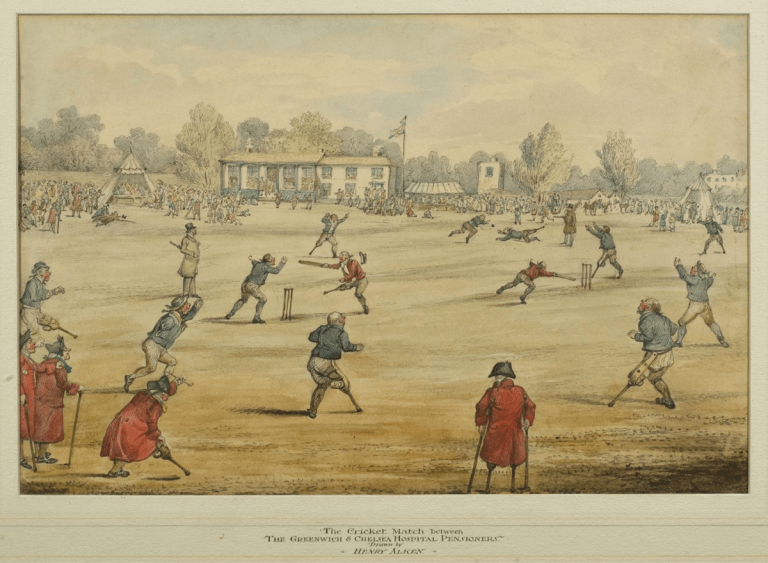
On Saturday, 13th August, 1796 the Hampshire Chronicle [7] printed coverage of a cricket match at Montpelier:
‘Tuesday, from the novelty of an advertisement announcing a Cricket Match to be played by eleven Greenwich pensioners with one leg against eleven with one arm, for one thousand guineas, at the new Cricket ground, Montpelier Gardens, Walworth, an immense concourse of people assembled. About nine o’clock the men arrived in three Greenwich stages; about ten the wickets were pitched, and the match commenced. Those with but one leg had the first innings, and got 93 runs. At about three o’clock, while those with but one arm were having their innings, a scene of riot and confusion took place, owing to the pressure of the populace to gain admittance to the ground; the gates were forced open, and several parts of the fencing were broke down, and a great number of persons having got upon the roof of a stable, the roof broke in, and several of them falling among the horses, were taken out much bruised.
‘About six o’clock the game was renewed, and those with but one arm got but 42 runs during their innings. The one legs commenced their second innings, and six were bowled out after they got 60, so that left off 111 more than those with one arm..’
The establishment of Aram’s New Ground at Montpelier seemed to coincide with the creation of the Montpelier Cricket Club circa 1796. George may have played a part in the club’s creation and after the gardens closed in 1844. the club morphed into what was to become Surrey CCC.[8]
George Aram died on 11th November 1813 after hearing the news his brother James had died:
‘Mr. Aram, of the Horse-shoe Inn, in the Borough. This event was communicated to his brother, Mr. Aram, of the Clock Cottage, at Walworth, who lately kept the Montpelier Gardens; he hastened to his brother’s, arrived just as the coffin was carried into the house, immediately complained of indisposition, was conveyed home, and died the following morning.'[9]
In a rather lengthy, but informative Will, George bequeaths Montpelier first to his wife Jane, and then to his brother:
‘And from and after the decease of my said wife I give and bequeath unto my said brother William Aram and ˄ Hetty his wife and unto the survivors of them all that my aforesaid leasehold estate called Montpelier House and Gardens with the several cottages and other premises included in the lease under which I hold the same to hold the same unto the said William Aram and Hetty his wife.'[10]
Jane Aram remarried, but still held the property in 1817.[11]
[1] Quarter Sessions. Registers of Licensed Victuallers. ARAM, George. 1795. QS5/10/2a. Surrey History Centre, Woking, Surrey. Collection: Surrey, England, Licensed Victuallers, 1785-1903. www.ancestry.co.uk : accessed 01 June 2019.
[2] Quarter Sessions. Freeholders Lists 1696–1824. ARAM, George. 1797. QS3/10A/5. Surrey History Centre, Woking, Surrey. Collection: Surrey, England, Jury-Qualified Freeholders and Copyholders, 1696-1824. www.ancestry.co.uk : accessed 01 June 2019.
[3] Ancestry. Search. www.ancestry.co.uk : accessed 01 June 2019.
[4] Land Tax. Surrey Land Tax. ARAM, George. 1795. 992363. Surrey History Centre, Woking, Surrey. Collection: Surrey, England, Land Tax Records, 1780-1832. www.ancestry.co.uk : accessed 01 June 2019.
[5] Southwark Council. (2015) Conservation Area Appraisal: Walworth Road. Appendix 3. Southwark Council. http://moderngov.southwark.gov.uk/documents/s60695/ : accessed 01 June 2019.
[6] South London Chronicle. (1887) Old Walworth. South London Chronicle. 05 November. p. 3a. www.britishnewspaperarchive.co.uk : accessed 01 June 2019.
[7] Hampshire Chronicle. (1796) Tuesday… Hampshire Chronicle. 13 August. p. 3b. www.britishnewspaperarchive.co.uk : accessed 01 June 2019.
[8] Wikipedia. (2018) Montpelier Cricket Club. https://en.wikipedia.org/wiki/Montpelier_Cricket_Club : accessed 01 June 2019.
[9] European Magazine. (1813) Mr. Aram. European Magazine. Vol. 64. p. 465. https://books.google.co.uk/ : accessed 01 June 2019.
[10] Testamentary records. England. 6 December 1813. ARAM, George. Will. Prerogative Court of Canterbury: Will Registers. PROB 11/1550. National Archives (Great Britain), Kew, England. Collection: England & Wales, Prerogative Court of Canterbury Wills, 1384-1858. www.ancestry.co.uk : accessed 01 June 2019.
[11] Land Tax. Surrey Land Tax. ARAM, Jane. 1817. 992365. Surrey History Centre, Woking, Surrey. Collection: Surrey, England, Land Tax Records, 1780-1832. www.ancestry.co.uk : accessed 01 June 2019.