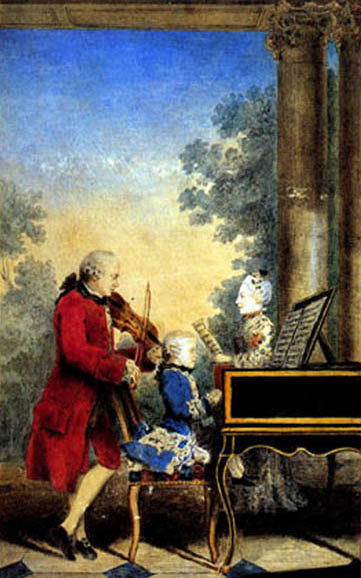
“When I left Salzburg I had not quite decided to come to England. But as everybody, in Paris particularly, urged us to go to London, I made up my mind to do so”.
Leopold Mozart and his family left Paris on 10 April 1764 and embarked for England at Calais. The money obsessed Leopold sacrificed comfort in favour of cost, by omitting emetics from their inventory, writing, ‘Thank God, we have safely crossed the Maxglanerbach*. Yet we have not done so without making a heavy contribution in vomiting. I, however, had the worst time of it. But we saved money…’
Once they had arrived at Dover, they were harrassed by twenty to forty people, all bidding to carry their luggage to the nearest inn, exclaiming to be “your most obedient servant”, whilst charging a high premium.
For Leopold, the oft portrayed money-pinching social climber, it was not the greatest of beginnings to a memorable visit, but the elder Mozart’s letters were engagingly penned with humour. From his address at the house of Mr Cousin, in Cecil Court, St Martin’s Lane he wrote to his friend Lorenz Hagenauer:
“In London everyone seems to me to be in fancy dress; you cannot imagine what my wife and my little girl look like in English hats and I and our big Wolfgang in English clothes”.
25 April 1764
The family were introduced to the King and Queen at the Queen’s Palace, St James’ Park (now Buckingham Palace) on 27 April; the hospitality they received appealed to Leopold who expressed that ‘the welcome which we have been given here exceeds all others’, whilst planning concerts to raise his family’s profile.
Wolfgang was supposed to perform at Hickford’s Room, Brewer Street, Golden Square on 17 May, however the concert was postponed until the 22nd, by which time the boy was indisposed. The following month Leopold managed to organise a benefit concert and carefully planned the event to coincide with the King’s birthday on 4th June, but was anxious about the number of attendees:
“Now we are going to give on June 5th a so-called benefit concert or concerto al nostro profitto… Each person pays half a guinea and, if it were winter, I could certainly count on six hundred persons, that is, three hundred guineas. Now however, they all go to the pleasure gardens and into the country… [Wolfgang] has now continually in his head an opera which he wants to produce there with several young people”.
Adverts were placed in the newspapers publicizing the event:
“At the Great Room in Spring Garden, near St James’ Park, To-morrow, June 5, at Twelve o’Clock, will be performed a grand Concert of Vocal and Instrumental Music.
“For the Benefit of Miss MOZART of Eleven, and Master MOZART of Seven Years of Age, Prodigies of Nature. The Vocal Parts by Signora Cremonini and Sig. Quilici. The First Violin with a Solo by Sig. Barthelemon. Violoncello with a Concerto by Sig. Cyri. Harpsichord and Organ by Miss Mozart and Master Mozart.”
Wolfgang was in fact eight and a half and Nannerl was twelve years old. After his initial anxieties, Leopold was happy with the concert attendance and takings:
“I had another shock, that is, taking in one hundred guineas in 3 hours…We had a week, or rather two or three days only, in which to distribute the “billets”, for before that date there was hardly anyone in London. But, although for this kind of concert four to eight weeks are usually necessary for the distribution of the “billets’, which here they call “tickets”, to the amazement of everyone there were present more than a couple of hundred persons, including the leading people in all London; not only all the ambassadors, but the principal families in England attended it and everyone was delighted. I cannot say whether I shall have a profit of one hundred guineas, as I have not yet received the money for thirty-six tickets from Mylord March and for forty tickets from a friend in town and from various others; and the expenses are surprisingly great. But the profit will certainly not be less than ninety guineas. Now listen to a few details about the expenses. The hall without lighting and music-stands costs five guineas. Each clavier, of which I had to have two on account of the concerto for two claviers, costs half a guinea. The first violin gets three guineas and so on; and all who play the solos and concertos three, four and five guineas. The ordinary players receive each half a guinea and so forth. But, fortunately for me, all the musicians as well as the hall and everything else only cost me twenty guineas, because most of the performers would not accept anything. Well, God be praised, that is over and we have made something… What it all amounts to is this, that my little girl, although she is only twelve years old, is one of the most skilful players in Europe, and that, in a word, my boy knows in this his eighth year what one would expect only from a man of forty. Indeed only he who sees and hears him can believe it. You yourself and all our Salzburg friends have no idea of Wolfgang’s progress ; for he is quite different now”.
8th June 1764
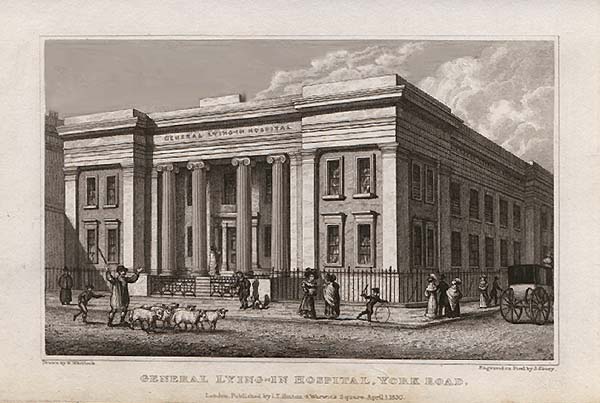
Later that month, a charity concert was organised on behalf of the General Lying Hospital in Surrey. The charity was instituted by Dr John Leake, an eminent writer on the diseases of women and was principally intended as an asylum for the wives of poor industrious tradesmen, and distressed housekeepers.
The concert occurred at Ranelagh Pleasure Gardens, situated on the banks of the Thames at Chelsea; of all the Pleasure Gardens, it was considered the most fashionable attracting the eighteenth century aristocratic glitterati. Horace Walpole, excited by the prospect of Ranelagh commented that, ‘You can’t set your foot without treading on a Prince or Duke of Cumberland’.
On 26 June 1764 the Public Advertiser heralded the concert indicating the presence of the Mozart family:
For the Benefit of a Public useful Charity
At RANELAGH HOUSE, on Friday next, will be performed (beside the usual Entertainments of Music and Singing).
At the End of the third Act, a very favourite Chorus in ACIS and GALATEA : Oh the Pleasures of the Plains, &c. To conclude with the Coronation Anthem, God save the King, &c. In the course of the Evening’s Entertainments, the celebrated and astonishing Master MOZART, lately arrived, a Child of 7 Years of Age, will perform several select Pieces of his own Composition on the Harpsichord and on the Organ, which has already given the highest Pleasure, Delight, and Surprize to the greatest Judges of Music in England or Italy and is justly esteemed the most extraordinary Prodigy, and most amazing Genius that has appeared in any Age.
A Porter belonging to the above deserving Charity, being employed to distribute Tickets for this Purpose, having lost a large Packet of 800 of them, it becomes therefore necessary to give this Notice, the Benefit designed for Wednesday the 27th, is, on that Account, postponed to Friday the 29th instant….
After the concert was postponed, Leopold wrote to Lorenz Hagenauer explaining his motives for allowing Wolfgang to perform:
“On Friday, June 29th, that is on the Feast of St. Peter and St. Paul, there will be a concert of benefit at Ranelagh in aid of a newly established Hopital de femmes en couche, and whover wishes to attend it must pay five shillings entrance. I am letting Wolfgang play a concerto on the organ at this concert in order to perform thereby the act of an English patriot who, as far as in him lies, endeavours to further the usefulness of this hospital which has been established pro bono publico. That is, you see, one way of winning the affection of this quite exceptional nation”.
28th June 1764
Leopold makes no further mention of the concert in his letters, probably because events had temporarily superceded his ambitions. His next letter dated 3 August describes an illness contracted after a chill caught on the way home from a concert.
By 13 September the family had taken a house belonging to Dr Randal in Fivefields-Row (now Lower Ebury Street), Chelsea, where, according to Leopold, they spent seven weeks. It was here that Wolfgang A Mozart composed his first symphonies K. 16 and K. 19.
*Maxglanerbach – He was comparing the English Channel to a tiny stream in Maxglan, Salzburg.
Sources:
Anderson, Emily, ed. The Letters of Mozart and His Family. New York, 1985.
Deutsch, Otto Erich. Mozart: A Documentary Biography. Stanford, 1965.