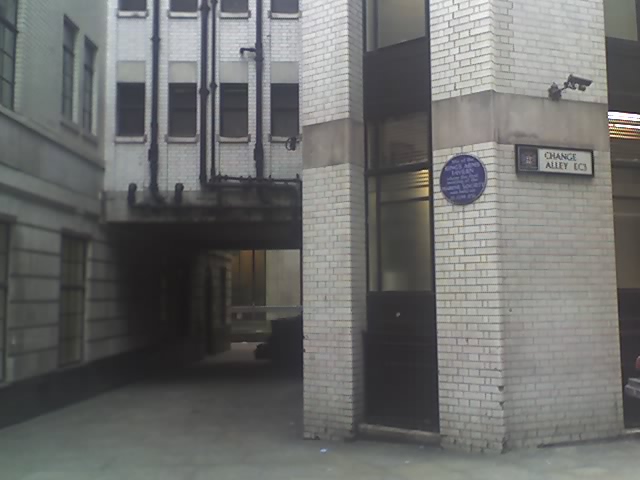
The Swan tavern, as it was originally known, was situated in Exchange Alley, Cornhill (now called Change Alley) and was the venue for a number of celebrated concerts long before any proper concert-rooms were able to accommodate London’s music lovers. The first concerts were initiated by Talbot Young and his friend and partner Greene purely as a weekly practice session in which Talbot played the violin and Greene the harpsichord. Intially Talbot and Greene met at Talbots’ residence at the west corner of London-house-yard, in St Paul’s churchyard, where his father John Young was a maker of violins. The fame of these ‘concerts’ began to spread and Talbot and Greene were joined by an increasing numbers of performers to such an extent that they outgrew their venue. A small subscription was set and they moved first to the Queen’s Head tavern in Paternoster Row and in 1724 to the Castle tavern also in the same street, setting their mark upon the institution by adorning the wall with a picture of Mr Young as painted by Woolaston.
Talbot Young continued to perform until the declining state of his health obliged him to quit; after which time Prospero Castrucci, and others in succession continued to lead the band. About the year 1744, the subscription was raised sharply from two guineas to five to enable the society to perform oratorios and so they removed to Haberdashers’ hall for the period of fifteen or so years and then finally to the Swan tavern, which by this time was known as the King’s Arms.
Whilst Young and Greene were creating a stir at the house in St Paul’s churchyard, a dancing master called Barton had began to attract concert-goers to his great room at the Swan tavern. Barton’s initial idea was to raise a subscription for a concert by tapping into the burgeoning resources of the merchant class and the city’s most opulent residents, attracting a number of first class musicians including Obadiah Shuttleworth, John Clegg, Abraham Brown and Michael Christian Festing.
Barton’s society flourished, but became fractious and was finally terminated by a fire on the evening of a performance on 24th March 1748, which consumed all the books and instruments, and among the latter a fine organ, and laid the house and adjacent buildings in ashes.
In 1749 Charles Burney was appointed to play the organ at the New Concert in the rebuilt King’s Arms and the venue continued at act as a concert hall for a number of decades.