Rather than write one long article about various 18th century masquerades, I found another glorious account of a masquerade similar to the one I wrote about earlier on this blog. Again, it is worth producing the newspaper report for the complete context, however some parts are illegible and will have to make do with my best guesses for this transcription!
Bath Chronicle and Weekly Gazette 20 October 1768
As the public conversation has been so much taken up of late, by the Masquerade which was given on Monday Night by his Danish Majesty, at the Opera-House in the Hay-market, it will doubtless be agreeable to our Readers to be informed of the following particulars relative to that sumptuous Entertainment.
The doors of the Opera-house, pursuant to advertisement, were opened for the admission of spectators in the gallery at seven, and for the masks at nine; early in the evening also a party of the guards was ordered upon duty at the Theatre, to prevent disturbances, which very much facilitated the access to the house, and produced a greater degree of order than could be well expected among the populace.
The number of tickets delivered out for the ball was so great, that many persons, fearful of finding admittance, thronged to the house the moment of admission; so that before eleven the concourse was prodigious, and the magnificence of the dresses, with the brilliancy of the illumination afforded a view inconceivably pleasing. The general satisfaction, however, sustained some diminution from the continual increase of company and the heat of the room, so that the dancers were very few, and several persons unable to endure the heat, were reduced to the necessity of unmasking before supper, when it became universal to unmask, and consequently put it out of their power to preserve the necessary propriety of their characters.
His Danish Majesty came in, masked, between ten and eleven o’clock, dress in a domino of gold and silver stuff, a black hat and white feather; walked about with great good-nature and pleasantry till twelve; then withdrew with a select company to supper, and appeared no more. The Princess Amelia sat the whole time in one of the boxes, masked. The King was in a private box, apparently shut, but with peep-holes in the shutters. The Duke of Cumberland was in a crimson domino, trimmed with gold, black hat and white feather. Duke of Gloucester in a purple domino, white hat and white feather. Her Grace the Duchess of Northumberland appeared in the character of Rembrandt’s wife, in a close black gown, trimmed with gold, a round-eared coif, short apron tucked up, with a painter’s brush in her hand. The character of Mungo in the padlock, was excellently assumed by Mr. Mendez, who was very fine in jewels, and exceedingly diverted the company. Dr. Dominiceti and his Lady, in the character of a Gardener and his wife excited much curiosity from the singularity of their dress, which was greatly admired. Lady Bell Stanhope and her sister represented Pilgrims, they wore brown gowns with blue sashes trimmed with silver, and small hats laced round with diamonds…
The Duke of Northumberland appeared in Persian habit, with a turban richly ornamented with diamonds.
Lord Grosvenor was in a splendid suit of the Turkish fashion.
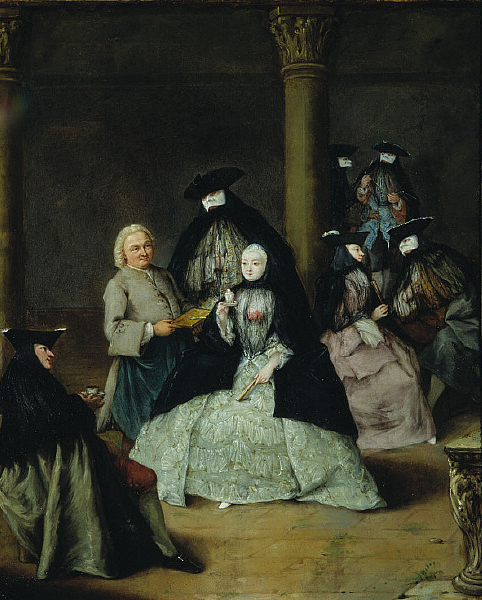
The Duchess of Ancaster in the character of a Sultana, in which she was universally admired, her robe being of purple sattin bordered with ermine, and flowing on the ground in all the pomp and state of eastern magnificence… A sweet little Shepherdess also, who was greatly followed by a tall agreeable Corydon, with a long crook, and dressed in a white silk jacket, ornamented with red ribbands and silver, attracted the notice of the spectators in a very eminent degree. When the Swain supported himself on his crook, the tender-hearted nymph asked him, “Why so pensive?” This produced a mighty soft reply, and gave birth to a conversation, which would make no mean figure in a modern Pastoral.
The stage was lined with crimson velvet, and illuminated round, which prodigiously heightened the grandeur of the scene. Six rooms were set apart for supper, in which a profusion of plate appeared. The tables were covered with all imaginable elegance, both of wines and eatables; and the magnificence of the dessert, in which were seen stately palaces, and beautiful landscapes, was beyond description…
At twelve the Royal Family, and the whole company, unmasked for the rest of the night. The ball was opened, with a few minuets, about two o’clock, and the dancing continued until six…
Wine and other provisions were handed up, by means of handkerchiefs to the company in the galleries, by their friends below, which at first produced some little dispute with one of the waiters, but this always being customary as well as an allowable practice, the dispute, by the prudent intervention of the officer on duty, soon subsided.
The whole, in short, was conducted with the greatest propriety and decorum; and, whether we consider the magnificence of the entertainment, the brilliance of the company, the richness of the dresses, or the splendor of the Ladies, who vied with each other, on this occasion in beauty and elegance, nothing perhaps has ever yet been seen equal to it, either in this or any other country…
The value of the jewels, which were worn on this occasion, was supposed to amount to not less than two millions of money.